

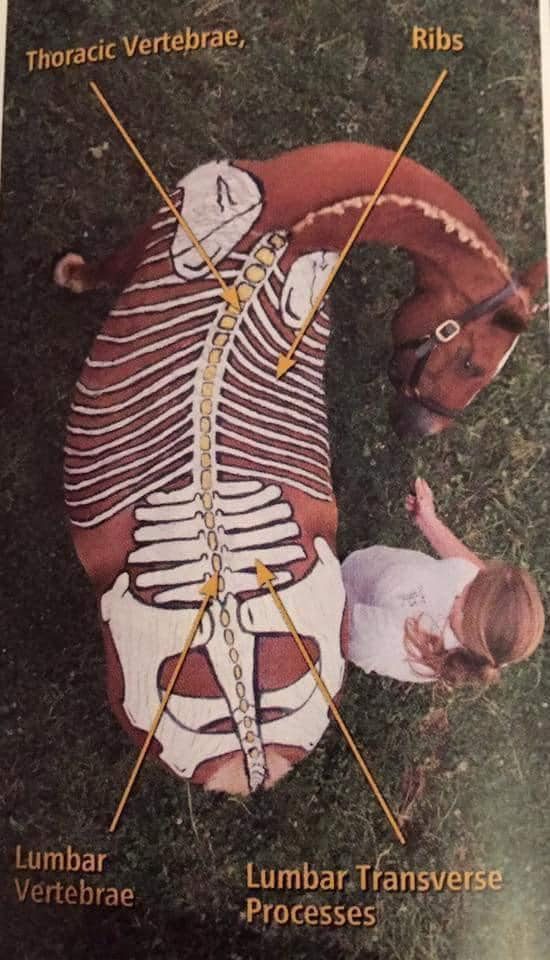
So often we hear or read that it is said that there is NO or LITTLE bend through the horse's body – that it is all an illusion coming from the bend of the neck and a little at the sachro-illiac joint where the lumbar vertebrae join and hinge with the sachrum; the fused vertebrae forming the roof to the pelvic ring and thence to the caudal vertebrae of the tail which again of course are extremely mobile.
Here, in this photo-diagram of a "carrot stretch" photographed from above, we see just how, in fact, there is a considerable amount of true lateral bend through the thoracic vertebrae. Indeed, in this case the bend does not follow through the rest of the body the compressed inner ribs simply impinge on the flank giving the impression the bend goes further back than it does – they need that space.
When you add full lumbar bend (this is limited due to the width of the lateral processes of the lumbar vertebrae but they are tapered and a little feathered to maximise it), flexion at the sachro-illiac joint and first few caudal vertebrae, the horse is indeed capable of very considerable lateral bend if we only mobilise it, maximise it and strengthen it.
That way, the five metre circle or classical 'volte' should be within the capability of all but the extremely large or thick set with short backs, who should be allowed the six metre volte if they truly need it in order to be ridden through the exercise with true bend, straightness and in vertical balance; bending around the support of the rider's inside leg.
In practice, few horses are suppled to this degree. Look at the corners of any manege, exercise area or schooling surface,,,,,, in most you will see that the ridden track around the corner in fact will only conform to a radius of 3 1/2 to 4 1/2 metres. Familiar???
That means that the horse is only, at best, conforming to a quadrant of a seven to nine metre circle at the corners. Watch them ridden, and you will probably see the horses banking, centrifugally, like a motor bike so that there is even less bend to the horse.
The horse that is not laterally suppled and flexible, is, by definition weak in the back. He will be strongly one-sided, not light, and probably, on close inspection go short in one hind leg – sometimes to the point of actual lameness, for NO other reason.
It is vitally important to address this issue if you want a strong athletic horse with a back that will carry you with ease, be light, support his forehand and be protected from needless strains and injury. This is a fundamental health issue, much neglected in modern training.
Next time you watch dressage, particularly at the higher levels, watch the corners and see how many scoot round with next to no bend, either banked in rather than in vertical balance or with the quarters flying.
This is not merely a flexibility thing, it is the most effective, if not only way to strengthen the back effectively. In repetitive stretching and contracting the muscles of each side, targeting more contraction, laterally to the weaker side and thus more stretch to the stronger, shorter side. We particularly target the longissimus dorsii, the long and important muscles along either side of the dorsal processes of the spine, the big muscles that carry the saddle and rider and plays a major roll in transferring the weight of the rider, his gear and varying degrees off the forehand back to the haunches.
For this sort of work to be effective, it is vitally important to ensure that the inner back on the circle, starts to lift and ultimately become stable in its contraction in order to secure true, deep lateral bend and vertical balance in turns and circles rather than being allowed to fall in, losing bend and returning to a centrifugal way of going which is a huge contributory factor in leg and back lameness.
Originally shared on the Prime Horse Property Facebook page on February 5, 2022.